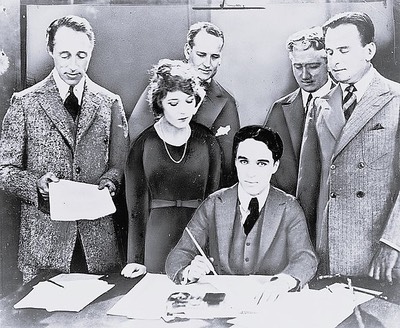
D.W. Griffith, Mary Pickford, Charlie Chaplin (seated), and Douglas Fairbanks at the contract signing creating United Artists (1919)
Contracts is a first-year course in common law jurisdictions around the world. Professor Russell is teaching Contracts during the spring 2023 to the excellent students at Washington University in St. Louis School of Law. He has also taught Contracts at the The University of Texas at Austin School of Law; UC College of Law, San Francisco; Maynooth University in Ireland, and the University of Denver.
A contract is an exchange relationship that is voluntary--more or less. The typical pattern is that one person (or company) sells goods or services to another person (or company) for money. For the most part, Contracts students examine what happens after something goes wrong with this transaction.
Contracts is a required course in the United States and Ireland--as well as in Canada, the United Kingdom, and Australia--because the concepts and methods are fundamental to being able to approach law as a lawyer. In this respect, the course is like an introductory course in a foreign language. If you can't talk contracts, you can't talk like a lawyer. Conversely, when you know the language, you can converse with lawyers in common law countries around the globe.
The course emphasizes the empirical and sociological realities of both business and the system of civil justice. In order to explain and defend the legal systems, students must learn what actually happens in the legal system.
In addition to focusing upon the empirical realities of business, litigation, and life, the course also considers some of the theories that explain and/or justify the rules that are supposed to guide contract law and litigation. Consideration of the these rules is divided into topics, including damages. Contracts considers the common law of contracts and, in the United States, focuses some attention on the Uniform Commercial Code--especially Article 2. This course prepares students to consider the law of Contracts in all common law jurisdictions.
As with other law school courses and with practicing law, being organized and thinking systematically is the key to doing well in Contracts